Parashari Jyotish workbench · by Shunya Kaal
Every layer of a Vedic chart, connected.
Vargas, Chalit, upagrahas, dashas and transits are calculated on the Swiss Ephemeris, linked into readable chains, and scored with the reasons shown alongside.
- Lahiri · Swiss Ephemeris
- Every score explained
- Private by default
D1 to D60
Gulika and Mandi
maha to prana
vs Drik Panchang
on every chart
How a reading flows
From the chart to a decision, one step at a time
Each step uses the output of the one before it, and you can audit every link. The data below comes from the sample chart.
Inside the workspace
Built for the consultation room
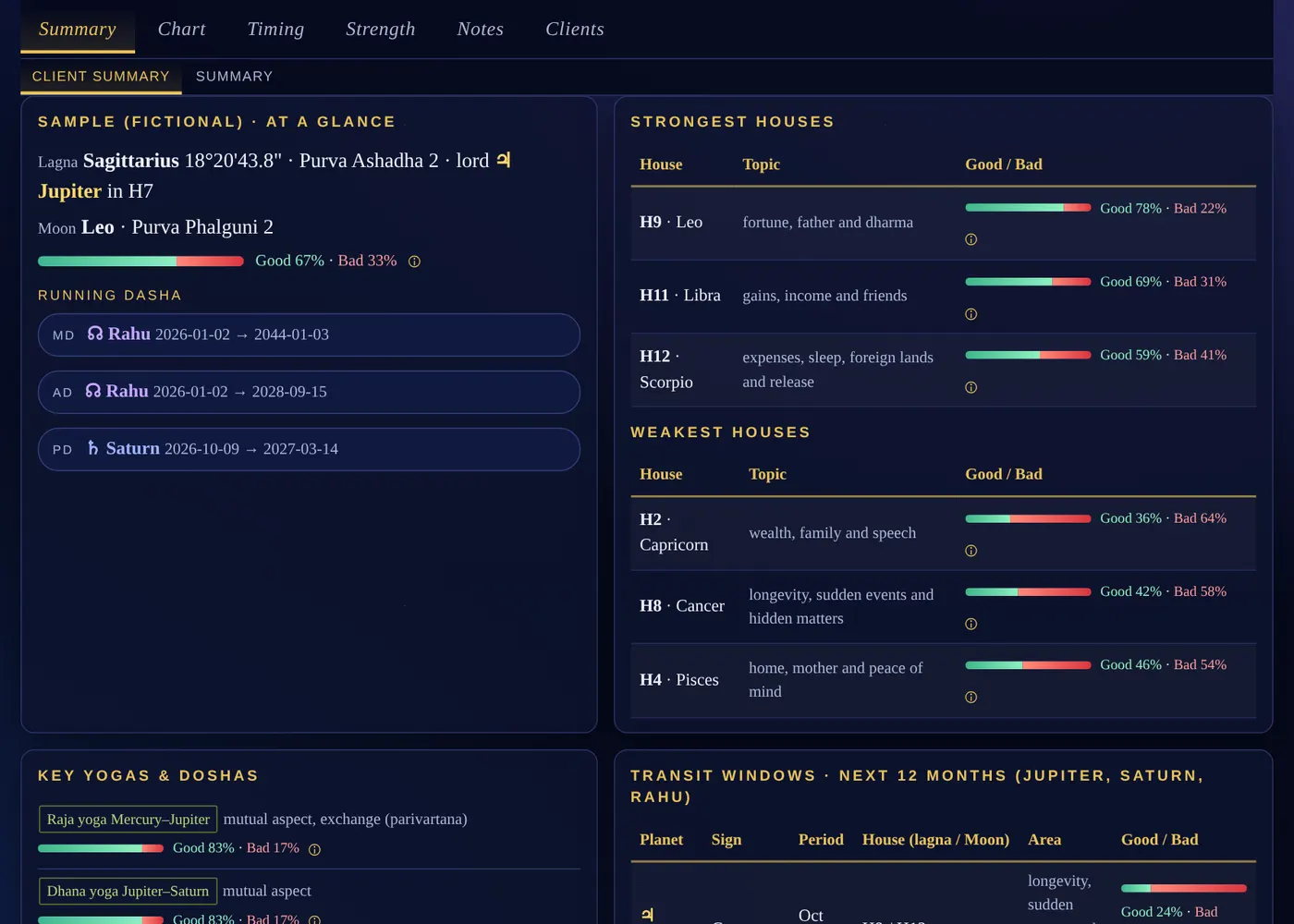
These are real screens from the app, shown with a fictional sample chart.
Accuracy you can check
Ingress times computed to the second, then checked against published values
Sign and nakshatra boundaries are root-found on Swiss Ephemeris sidereal longitudes (Lahiri, mean node). Retrograde re-entries are listed as separate events. The comparison is part of the automated test suite.
- Dasha boundaries carried down to prana
- SAV per sign never 0; total always 337
- Chalit cusps matched to a published Sripati method
| Ingress | Published | ArthaSense |
|---|---|---|
| Saturn → Pisces | 29 Mar 2025 21:44 | 21:45 |
| Jupiter → Gemini | 14 May 2025 22:35 | 22:36 |
| Jupiter → Cancer | 18 Oct 2025 19:46 | 19:48 |
| Jupiter ℞ → Gemini | 5 Dec 2025 17:46 | 17:24* |
*Near a station, Jupiter moves only a few arcseconds a day, so small differences between Lahiri implementations become minutes.
Transparent by design
Each Good% and Bad% lists the factors behind it. Nothing is a black box.
Periods, not dates
Timing is given as dasha sub-periods aligned with transits. When the birth time is uncertain, windows are marked as not auditable.
Private by default
Client records, notes and predictions stay on your own server, behind your login, and are backed up daily.
Your charts, your notes, one workspace.
ArthaSense is a private practitioner tool.
Login